
 #All
#AllWhat Causes Dark Circles Under Eyes?
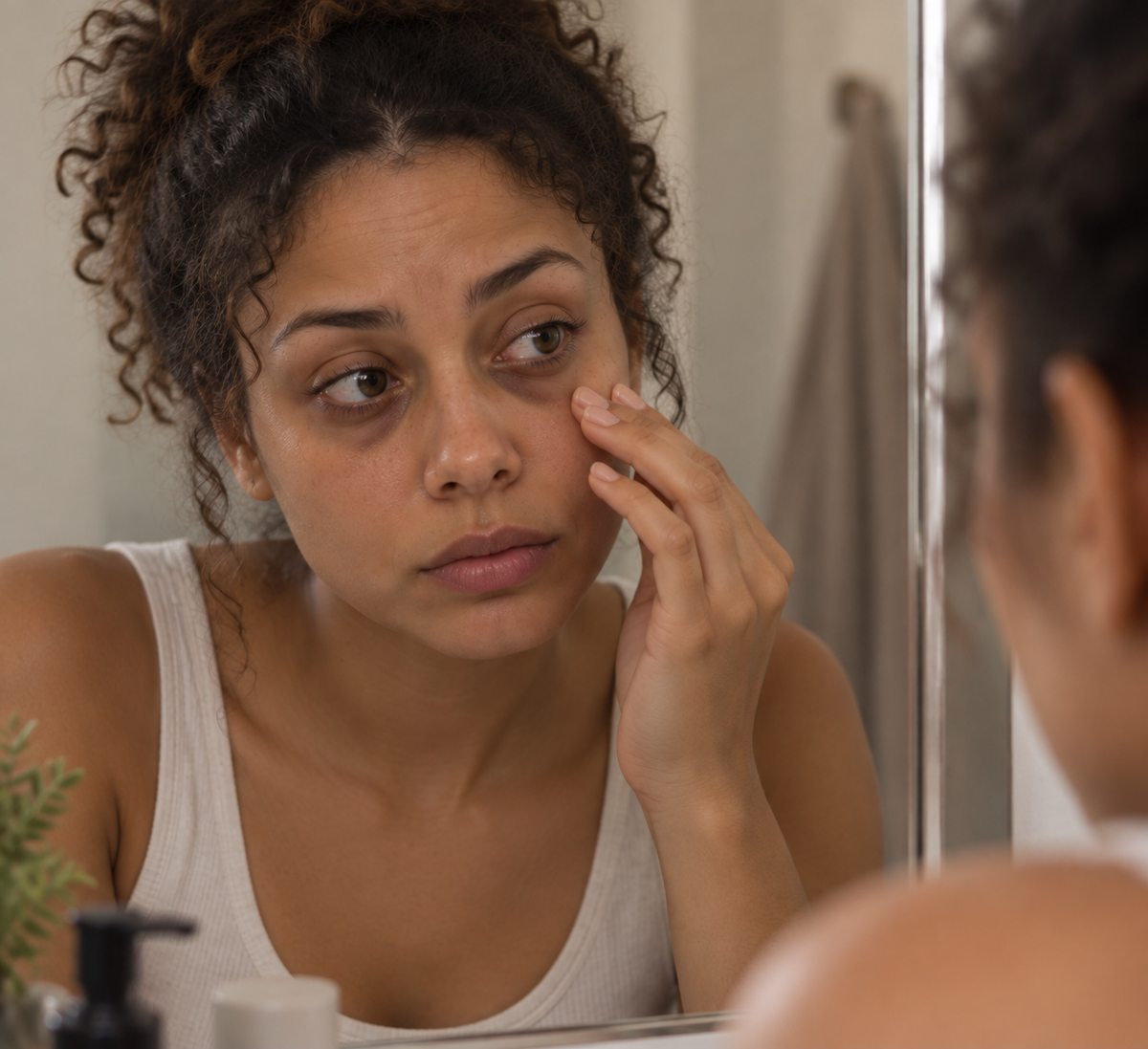
Dark circles are treated as a single problem with a single solution, which is why most of what people try produces so little. They have at least four distinct causes, and a treatment that works well for one does nothing for another.
Sleep is the assumed explanation and rarely the main one. Skin thickness, pigmentation, blood vessel visibility, and the shape of the bone beneath the eye account for considerably more, and none of them responds to an early night.
What Causes Dark Circles Under Eyes
The skin around the eyes is the thinnest on the face, measuring a fraction of the thickness of cheek skin, and it sits directly over a dense network of blood vessels. That combination is the foundation of most under-eye darkness, since anything beneath the surface shows through more readily here than anywhere else.
Four mechanisms account for nearly all of it. Melanin can accumulate in the skin itself, producing genuine pigmentation. Blood vessels close to the surface can show through translucent skin, producing a blue or purple cast. The bone and fat structure beneath can create a hollow that casts a shadow regardless of what the skin is doing. And the tissue can retain fluid, which produces puffiness that reads as darkness through the shadow it throws.
Most people have more than one of these at once, which is why a single product rarely resolves the appearance and why identifying the dominant cause matters before spending anything.

The Four Types of Under-Eye Discoloration
Each type looks different under close inspection, and each responds to different things.
| Type | What it looks like | Underlying cause |
|---|---|---|
| Pigmented | Brown or grey-brown, evenly distributed | Excess melanin in the skin itself |
| Vascular | Blue, purple, or reddish | Vessels showing through thin skin |
| Structural | Darkness that follows the orbital rim | Hollowing from bone and fat position |
| Mixed | Two or more of the above together | Combination, most common in practice |
Pigmented circles are more common in medium to deep skin tones and tend to be the most persistent. Vascular circles are more common in lighter skin tones, where translucency is higher, and they fluctuate with fatigue, hydration, and time of day.
Structural circles behave differently from both, since nothing about the skin has changed and the darkness is a shadow rather than a color. They are largely inherited, becoming more pronounced with age as fat pads shift, and they are the type that responds least to anything applied to the skin.
How to Tell Which Type of Dark Circles You Have
Three quick tests separate them, and they take a mirror and about a minute:
- Stretch the skin gently sideways. If the darkness lightens or disappears, it is vascular, since stretching disperses the blood beneath. If it stays, it is pigmented.
- Press lightly with a fingertip and release. Vascular darkness blanches briefly and returns. Pigmented darkness stays the same color throughout.
- Tilt your face upward toward a light source. Structural darkness lightens considerably as the shadow fills, while pigmented and vascular darkness stays put.
Comparing morning and evening adds a fourth signal. Vascular circles and fluid-related darkness fluctuate through the day, often looking worst on waking, while pigmented circles look identical at eight in the morning and eight at night.
Anyone finding the darkness stays constant under every test is probably dealing with pigmentation, and anyone finding it shifts under all of them is likely dealing with a mix.

Do Dark Circles Come From Lack of Sleep?
Poor sleep contributes and rarely causes them outright, which is why people who correct their sleep are often disappointed by the result.
What sleep deprivation does is make existing circles more visible. Skin looks paler when tired, which increases the contrast against vessels beneath it, and fluid retention from lying flat overnight adds a shadow that resolves through the morning. Neither creates pigmentation or changes the structure of the orbital area.
The evidence for this is visible in anyone who sleeps well and still has circles, which is a large proportion of people with the pigmented or structural types. Genetics, skin thickness, and bone structure are fixed regardless of how rested someone is.
Sleep is still worth correcting, since it affects how pronounced the appearance is on any given day, and dehydration and alcohol work the same way by making vascular circles temporarily worse. What none of them do is address the underlying cause.
Under-Eye Pigmentation by Skin Tone and Genetics
Periorbital pigmentation is more common and more persistent in medium to deep skin tones, where melanocytes are more reactive and produce more pigment in response to inflammation, friction, or sun exposure. It frequently runs in families and often appears in childhood or adolescence rather than developing later.
Sun exposure compounds it, since ultraviolet light stimulates the same melanocytes that an inherited tendency has already made active, and the under-eye area is routinely missed by sunscreen. Rubbing the area, whether from allergies, eye-makeup removal, or habit, produces post-inflammatory pigmentation that accumulates over years.
Lighter skin tones more often show the vascular type, since thinner and more translucent skin lets the vessel network beneath show through more readily. That type fluctuates far more, responding to fatigue, temperature, hydration, and hormonal changes in ways pigmented circles do not.
Structural hollowing crosses all skin tones and is the most strongly inherited of the three, with people frequently recognizing the same under-eye shape in a parent or sibling.
What Reduces Dark Circles
Matching the approach to the type is what separates a routine that works from one that produces nothing.
For Pigmented Circles
Ingredients that interrupt melanin production do the work here, including vitamin C, niacinamide, azelaic acid, and retinoids introduced carefully, given how thin the skin is. Daily sunscreen matters more than any of them, since continued exposure deepens pigmentation faster than most treatments fade it. Results build over three to six months rather than weeks.
For Vascular Circles
Improving skin quality and circulation is the route, since the goal is reducing translucency rather than removing anything. Caffeine constricts vessels temporarily, cold compresses do the same, and better collagen density in the skin above makes the vessels less visible over time. Sleep, hydration, and reduced alcohol all affect how pronounced they look day to day.
For Structural Circles
Topicals do very little, since the darkness is a shadow rather than a pigment. Dermal filler is the treatment that addresses it directly, and concealer works by filling the shadow optically. Improving skin quality helps marginally by reducing the contrast at the edge of the hollow.
For Mixed Circles
Treat the dominant type first and reassess after three months, since resolving one component often reveals how much of the appearance the other was responsible for.
Light therapy cuts across three of the four, supporting skin density for vascular circles, turnover for pigmented ones, and overall quality where circles are mixed, though it does nothing for structural hollowing. How it works and where it stops is covered below.
How LED Light Therapy Helps Dark Circles
Light therapy addresses the skin rather than the pigment or the structure, which determines both where it helps and where it does not.
Red light at around 633nm and near-infrared at around 850nm are absorbed by mitochondria in the dermis, supporting the cellular energy production fibroblasts use to produce collagen and elastin. A randomized trial using these wavelengths recorded improvements in elasticity alongside histological increases in collagen, and thicker, denser skin above a vessel network makes that network less visible, which is why vascular circles respond best of the four types.
Pigmented circles respond more slowly and less predictably. Improved skin turnover helps clear excess melanin over months, and green light at around 525nm works at the depth where melanin sits, though the evidence behind green is considerably thinner than for red, and it belongs alongside topical treatment rather than instead of it.
Structural hollowing does not respond, since no wavelength reaches the bone or fat producing the shadow. Anyone whose darkness lightens dramatically when they tilt their face toward a light is dealing with that type, and a mask will improve the surrounding skin without changing the shadow itself.

What to Look for in an LED Mask
Coverage around the eyes is the first thing to check, since a considerable number of masks leave the eye area open entirely, which protects the eyes and leaves the skin that needs treating untouched.
Built-in eye protection is the better solution, allowing LEDs to sit close to the orbital area while shielding the eyes themselves. Fit matters here more than anywhere else on the face, because the orbital bone creates a contour that rigid masks bridge rather than follow, leaving the light further from the skin exactly where it needs to be closest.
Wavelength range decides how much of the picture one device covers. Red with near-infrared addresses the vascular type through improved skin density, and green extends the same device to pigmentation, which matters given how many people have both.
The RegenaLight Wireless LED Light Therapy Mask carries 143 medical-grade LEDs at 30mW/cm², running red at 633nm and near-infrared at 850nm alongside green at 525nm, blue, yellow, cyan, and white, with built-in eye protection so no separate goggles are needed. Sessions run up to 15 minutes, and the mask charges via USB.
Conclusion: Reducing Dark Circles Realistically
Dark circles rarely have one cause, and the most useful thing anyone can do before buying anything is work out which type they have. A mirror, a gentle stretch of the skin, and a light source separate the three main possibilities in about a minute.
Vascular circles respond best to anything that improves skin density, which is where light therapy earns its place, since red and near-infrared thicken the skin sitting over the vessel network rather than acting on the vessels themselves. Pigmented circles respond to melanin-targeting ingredients and sun protection over months, with light therapy supporting the process rather than driving it, and structural hollowing responds to filler or concealer rather than to skincare of any kind. Most people have a mix, which is why partial improvement is a more realistic expectation than resolution.
Sleep, hydration, and reduced alcohol affect how pronounced circles look on any given day without changing what causes them, so correcting those is worth doing while expecting a change in degree rather than in kind.
Related Articles
#All #All
#AllBest Skincare Routine for Women Over 50
Read More #All
#AllWhat Does Blue Light Therapy Do?
Read More #All
#AllHow Often Should You Do Red Light Therapy?
Read More #All
#AllHow to Use Red Light Therapy With Retinol
Read More #All
#AllRed Light Therapy for Wrinkles
Read More #All
#AllLED Light Therapy for the Neck and Chest
Read More #All
#AllDoes Red Light Therapy Work?
Read More #All
#AllRed Light Therapy for Sensitive Skin
Read More #All
#AllLED Light Mask Treatment: A Smarter At-Home Skin Routine
Read More #All
#AllLED Mask Results and Timeline
Read More #All
#AllWhen to Start Using an LED Mask
Read More #All
#AllWhat Causes Dark Circles Under Eyes?
Read More #All
#AllLight Therapy for Adult Acne
Read More#All
The 10 Best LED Light Therapy Face Masks for Acne in 2026
Read More#All
The 10 Best Affordable LED Face Masks in 2026
Read More
/
Featured Products
Our most-loved products, hand-picked for you.